Friday, February 15, 2008

Playing with food never felt so artistic.


Enjoy here the bizarre and outright wild stylings of the Vienna Vegetable Orchestra, a group that generates its music exclusively from specialized produce they pick up from the grocer the day of the show.

The instruments require occasional lubrication during the performances, as the hot lights of a stage performance will begin to dry the raw plants, and that can apparently change the sound various carrot recorders and cucumberophones make, so they much dip them in water between pieces and sets.

The best part? They make a soup out of the instruments after the show and share with the audience.

Tuesday, February 12, 2008

Fabulous Games and Prizes - in the lab.

I'm sure many readers are aware of the X Prize for various goals reached in commercializing the space race, as illustrated by the landmark (spacemark?) achievement by SpaceShipOne in 2004. But did you know there are X Prizes for cell crushers too?

There's another cool 10 million bucks out there for the ability to cut the cost of genomic sequencing into the affordable range, that is, to sequence one person's entire genome for less than a thousand dollars.

There appears to be several groups that are going to make this a photo finish.

The possibilities of such a cheap and afforable technology are staggering, as one's genome would become core information in medical files, allowing treatments and therapies to be targeted with greater precision.

I recall in 1994 as a college freshman I went to a seminar with a representative of the Human Genome Project, then working on merely sequencing a composite of the complete genome. I was told of the industrious effort being put into this project, a thousand computers crunching millions of numbers non-stop with a target of around 2006. Not only did the HGP beat that goal by a long shot, they were almost usurped by a private company! The merger into the HGP is its own sordid story, alas. Never the less, the acceleration curve of our technology is staggering sometimes.

Monday, February 11, 2008

Like a big 'You Are Here' sign

I'm sure you've heard of the news last month of UFO sightings in Stephenville, Texas. One of my colleagues queried me if I felt there was any legitimacy to the story - could the UFO actually be some intelligent and advanced alien life?

Unfortunately, my answer is a dull almost certainly no. I feel there is plenty of good evidence to suggest life as we know it could arise independently across the universe. Given we have at least a grasp that how things are put together here (like stars and matter) this is probably how they are put together elsewhere. Also, given the vastness of space and the cosmically short time it has taken us to go from polymer goo to intelligent life, it seems ignorant to assume we are in some special and unique nook of the Big Everything, and everywhere else is just void storage.

That said, I also think us meeting up with another indendently arising alien race is also unlikely, for the very same enormity of the universe.

Our little probes, our pollution of the planet, our TV, radio and light waves, even our active search for aliens are riding on a lot of luck to suddenly be noticed by anyone, even if they are taking a hard look at our solar system.

The real trick would be to construct something BIG, and I think Jaron Lanier has the right idea: start moving stars around. Lanier proposes building up a fleet of gravitational tugs or tractors to move objects around, eventually one could get enough of them to start influencing a star's movement. From there, the idea is simply one of scale:

Why move stars around? Because then they could be guided into orbital formations that almost certainly would not have occurred naturally. An imaginable set-up period of tens of thousands of years could therefore be leveraged into a much longer period—billions of years, perhaps—during which aliens could observe the fruits of our efforts. A group of stars organized to present a sign in this way might be called a “graphstellation” (like a constellation, but also a form of writing).

Yeah, the bumps in the roads are almost as big as the objects that are being suggested to be moved into some sort of kitschy Vegas eyesore. Still, I think this is the first proposal I've heard of that even gets close to achieving what so many people feel they've done in Stephenville, Texas - get noticed by little green men.

Friday, February 08, 2008

The Six Million Watt Man (1.2 million miles of travel not included)

A research team unveils a device that convert leg energy into electrical energy. In principle its exactly how hybrid cars can use the deceleration of a car by braking as a harvest point for gathering up some extra electrical juice.

As the team reports tomorrow in Science, the braces produced 5 watts of power--enough to run 10 cell phones.

Now we're talking. I'd love to have a little bioelectric zappage on hand for my cell phone and even an LED flashlight. I suppose if I ever had a laptop it would be good motivation to get enough power to turn it on.

The prototype appears lightweight (1.6kgs). I wonder if a more industrious individual could strap on a battery and bank some of those watts, eh? It'd be pretty neat to be able to not have to plug my cell phone in every night and just have it charge as I tool about the lab. Of course, the more noble applications such as insulin pumps and prosthetic limbs, but man, I'd love to drop another chore off my daily decompression routine when I get home from work.

I guess they're still working on getting that USB port for the brain.

Thursday, February 07, 2008

Weather didn't do this Atlantis in

Atlantis lifted off this afternoon despite threats both from gloomy weather and a faulty fuel sensor.

This is a huge mission as the Atlantis shuttle is taking up the Columbus science lab, a five billion (with a BUH) dollar module built by ten European nations. The lab is going to more than double the amount of science that can be done on the international space station once the Atlantis crew gets it attached and running.

I still recall in grade school getting to put down the composition and times tables once every few times a year to watch the shuttle lift off on a TV strapped down to a cart in the glorious theatre that was my classrooms. I may not always agree with the government's expense of funds, but the exploration of space never ceases to feel like a most righteous investment and spectacle.

Wednesday, February 06, 2008

Micro Machines - Fast Talking Spokesman not included

In Korea a research team has built a really tiny robot. This robot, with six crab legs and being no thicker than a fingernail, is powered by rat cardiomyocytes, heart cells coated over its body. When the cells contract, the legs are pulled together, and the mini-cyborg inches forward, averaging about 100uM a second and close to 50 meters in a week. The robot is fabricated the same way we mold parts for things like cars or toys, just on a very small scale.

Check out the robot walker action here.

So what's the application, eh? Theoretically one could send these tiny robots into the smallest of blood vessels and gland ducts the way we send pipeline pigs into fuel lines for maintenance and information gathering missions. The tiny cyborgs could march in and collect valuable data and perhaps in later versions, effect repairs. That's a ways off, since the robot is going to need to be sturdy enough to force its way through flowing blood, but really, at this point its only a matter of engineering, not principle.

Tuesday, February 05, 2008

A bucket of coke and a better built house: Fat America

A fantastic new book out, the Fattening of America attempts to get a real headlock on the hard questions as to why and how Americans have become so alarmingly obese. This is the first book I've read that takes a moment to ask a question most books gloss right over: Is a big Fat America a bad thing?

In the book, Eric Finkelstein, a health economist argues that our economy, with its massive increase in productivity through technology, has predisposed us to gaining weight. Our jobs have become more and more sedentary and new medical technology has overall lowered the risk of carrying a few extra or a few dozen extra pounds. The power saw and mechanical lifts have preserved the backs and knees of our construction workforce, but it also allowed them to get chubbed and diabetic. At the same time, our accelerated productivity has made things cheaper and more accessible to the bulk (no pun intended) of the population.

This book also intersects with an intriguing study out this week about how living longer is more expensive than being fat. For many years people have laid into the argument that being obese, and as such being more vulnerable to a host of metabolic diseases is a drain on the health care system. Indeed it seems a healthy individual with a longer life span will have a greater financial impact on government run and private health care than any group of obese individuals could do so.

Clearly in the end there's a lot of non-salient factors such as one's happiness, the impact of obesity on relatives and discrimination and social perception of obesity that aren't well covered here, but this book is truly the first in its field to crack open a lot of stronghold notions that have since gone unchallenged.

Monday, February 04, 2008

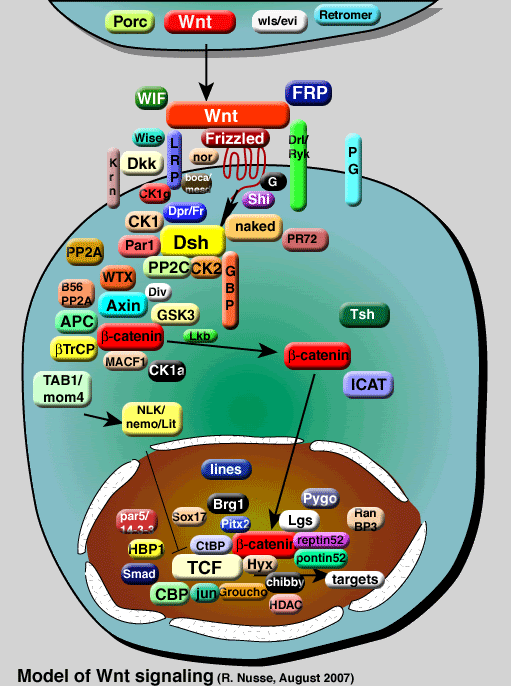
He Wnt that way


Today marks the beginning of Just Science 2008! The Sequel! To kick things off at the Ripsaw, we're delving into a crossover of some of the work I currently research as well as one of my favorite topics, signal tranduction.

Organization within a multicellular body like ourselves or sea cucumbers means we have a lot of cells that all need to be coordinated together, which if you try to think about the enormity of that task as a whole for more than ten seconds, blood will shoot out of your nose, which, ironically would also be a complex symphony of signals amongst literally trillions of cells.

So in a very tiny nutshell, scientists working in the fields of developmental biology and molecular genetics have contributed a mountain of data on these systems, and we still only have the most rudimentary grasp on how it's all put together. I'd equate our knowledge of how the various molecular players in the body turn my morning oatmeal into fuel for typing this similar to saying all you know about a car is you put gasoline in this one hole and that makes it go.

Numerous molecule families have been described and one group that is involved in the dermal remodeling project I currently work on is the Wnt family. Wnt proteins are chiefly paracrine signalers, which means when a cell releases a Wnt molecule, it has a local effect on the tissue. This is in contrast to an endocrine signal such as hormones or other molecules that travel long distances from places such as the brain or thyroid to their target cells. As such, paracrine factors like Wnt molecules have a diffusion effect, their strength of signal proportional to the distance they travel from the cell of origin.

Wnt factors are rich in an amino acid called cysteine which contains sulfur, an atom that allows for some fancy bonding schematics in secondary structures of proteins. The Wnt family is a very old signaling factor and is highly conserved throughout the animal kingdom, found in just about every animal for which it has been probed. In all likelyhood it is the oldest of the signaling factors.

The name Wnt is pretty odd, eh? As is the case with science, we tend to have problems all having the same name for the same molecule, but this is a result of us knowing so little to begin with. Researchers who found the molecule in the Drosophila fruit fly decided to call it wingless since blocking the signal caused the flies to have no wing development. Scientists studying the same factor in vertebrates called it integrated for its role in developing muscle cells in early somite patterning. Once it was established that wingless and integrated were the same thing, a new compromise name was fused together, Wnt.

As someone who has a hand in stem cell research in the hair follicle, Wnt is constantly being brought up as a potential player in the development model. Given its wide-reaching influence in cell-cell interactions, it is often just the big family in the room everyone wants to throw at a model like this. Recent research has certainly suggested the idea is more than plausible, instead of the body just quickly throwing up some scar tissue to secure a wound, it may be possible to turn Wnt genes back on and get the body to create new skin including hair follicles and glands from the foundation up, which would be preferable in so many ways ranging from therapeutic to cosmetic.

The future of Wnt research is a fertile, rich land. New, exciting research ideas surrounding aging are being launched with the Wnt family in mind. In theory, if one can organize a master organizer like Wnt, it might indeed be the secret to tricking the body into thinking it's 21 instead of 61.

Many thanks to the Nusse Lab at Stanford for their great Wnt cartoons and wealth of research on the topic!

Tuesday, January 29, 2008

The Caffeinator (He'll be back real quick)

We at the Ripsaw enjoy a strong, punch-in-the-face type cup of coffee in the morning, be it Sumatran, Ethiopian or plain or Starbucksy Arabica Breakfast Blend. Indeed, caffeine is often hailed by yours truly as a brain enhancer, a focus accelerant and an all around answer to life in the early hours of the day.=New research, however, shows there is a darker side to caffeine, and it's not all French Roast.


Caffeine mucks with insulin in diabetes.


Caffeine increases risk of miscarriage.


I think there's a unifier here. Caffeine works its magic by keeping a molecule known as cAMP from degrading. With lots of cAMP around, the brain can continue functioning when it would typically trigger fatigue and sleepiness as cAMP levels dropped. Keep the supply fresh and you can go much longer, so to speak.

Here's the thing: cAMP is a nigh-universal metabolic messenger, and is involved in both the metabolism of food as well as complex parts of the reproductive pathways. If you keep cAMP high through caffeine dosing, you're unbalancing something in the body, and in the case of diabetics or pregnant women, there's a much bigger risk involved.

Not that this should keep you from your favorite caffeinated beverage of choice, but perhaps coffee isn't the panacea wunderdrug we'd all like it to be.

Monday, January 28, 2008

You wonder who funds them.

America's Funniest home videos wacky science papers.

I'm not sure how farts keep one's personality together, but I'm listening.

Sunday, January 27, 2008

At the corner of vanity and therapy.

Stem cells give a peak into a possible melanoma breakthrough.

This is actually follow-up research on another breakthrough, the demonstration of a group of receptors, the, yes - ABC family - are key markers for tumor cells. In essence, this can be a unifying tag on the surface of tumor cells that set them apart from the rest of the normal, noncancerous cells in the body. Based on that tag, a therapy might be developed that could use that tag as a target. As mentioned, there are considerations; this receptor, ABCB5, does indeed have a function elsewhere in the body. This is the classic example of what the drug industry likes to call 'side effects'.

Of course, the rub is that melanoma is largely a self-inflicted form of cancer, with the vast majority of cases arising from sun exposure. Might want to make your hat for next summer bigger and floppier, neh?

Wednesday, January 23, 2008

Hopefully we can remember where we put those extra cells

New preliminary research out of UC-Irvine shows the discovery of a creator gene responsible for differentiating cells into brain tissue. This is a key element in creating a stem cell line of cells that could be used to regenerate brain tissue in patients with diseases like Alzheimer's.

These genes are highly selective, and likely only operate in a small window of time during early development. It would be interesting to see what a homolog gene does in other organisms, as it might provide insight as to how we got our big juicy think-globs. Mmmmm, thinky.

Thursday, January 17, 2008

Exciting new frontiers

Hey there!

Between a rush of holiday activity and a near month of malaise the Ripsaw had gone dark. Hopefully I'll be able to bring you the tasty science news you desire in the future. In the meantime, the world of stem cells has been all a quiver...

Human heart tissue grown from stem cells. A real great leap given the times, this is the leap from mere bits of progenitor cells towards something that might be used to build a new heart that could be put into use to save lives. These would be grown on a scaffold of collagen, which dovetails on previous Ripsaw reports.

Singapore considering human-animal chimeras. This is the type of bold research you'd expect Singapore and perhaps Taiwan to champion, so it will be interesting to observe what comes of such research. Without a doubt, these 'cybrid' studies will be essential to carefully bridging stem cell applications to people.

Tuesday, November 20, 2007

Another big hurdle.


Two research groups form human embryonic human stem cells from somatic tissues.

The actual data can be found here and here.

Woooo boy. This is potentially a big jackpot for science, as it would have a twofold effect. One, the techniques described are fairly simple where any cell lab with tissue culture facilities could likely generate these lines. Two, it would probably get the religiously outraged off the backs of scientists as well. I say probably because it's unclear whether a embryonic-like stem cell line still qualifies as life in need of protection, considering the bizarre demarcations they currently use are rather arbitrary.

A couple observations.

First, both techniques use an ecotropic retrovirus, which is probably completely out of the question for therapeutic use. There's nothing to inactivate this in the system described. Perhaps more of a concern is the cocktail of genes used, where both labs use a pair of oncogenes, or cancer-promoters. Naturally these kind of genes encourage the kind of proliferation you see in stem cells, but it clearly could pose a more immediate danger in the body.

More importantly, while these findings are very exciting, it remains to be seen how viable they are in the pursuit of stem cell therapies, which is the endgame scenario for this research. Until the process is entirely vetted it should not be hailed as some singular panacea to the controversial debate, and is likely to generate new problems that were out of reach previously.

Friday, November 09, 2007

When one of my cultures die, I die a little inside, too.


Scientists construct a stem cell scaffold from seaweed products.

Now, as compared to yesterday's antics, this kind of technology is taking a credible step towards legitimate therapeutic applications. Stem cells in culture are notoriously picky; they typically like to be fed only from one side, need to have their media changed routinely and need to be grown on special membrane substrates. Ostensibly, this presents a problem in the body, where such furnishings are unlikely to be found. An inert scaffold presents its own problems - what happens when you need to take the construction equipment out after everything has grown over?

Ashton, created the device from a material known as alginate. Alginate is a complex carbohydrate found naturally in brown seaweed. When mixed with calcium, alginate gels into a rigid, three-dimensional mesh.


This is a real clever synergy of biochemistry, materials science and engineering. I'd call it the great grandson of the modern disposable diaper, another life saving invention.

Thursday, November 08, 2007

FecundoCapitalism

Hey, Ladies.

Are you worried your monthly miracle is going down the drain? Literally? C'elle to the resuce! For a mere $1500 a year this company will take your glorious discharge and all its potential stem cells and keep it nice and safe in the event you might want it back, to, uh....well really, there's nothing you can do with it right now.

Honestly, this venture is long on optimism and short on evidence. Their product is hope, not an actual scientific technique.

But let's not be too hasty, as Dave Foley from the Kids in the Hall once said...

Cause after all, what is it? a cluster of blood vessels, awaiting a fertilized egg. Providing a safe warm place for that egg to grow. And if a life does not occur, the whole thing is flushed away, and the cycle begins again. Now is that anything to be ashamed of or disgusted by? No, this is the nesting stuff of humanity!

That's why the woman I shall love will be able to menstruate as fully and freely as she desires. Even if her monthly flow should build in intensity to a raging rust colored torrent! An unbridled river of life giving blood flowing from between her legs! An awesome cataract plunging off the edge of our couch. I wouldn't be fazed! No, no, even if coureur de bois would come up stream, battling the rapids, and singing a 'jaunty song'! I would take no offense, rather I would ford across that mighty womanly river, and fetch herbal tea and Pamprin. And then I would mop her brow and admire her fecundity. For I...Have A Good Attitude....Towards MENSTRUATION!

Wednesday, November 07, 2007

Taste the Brainbow


Stem cells may secret brain repair substance. What happens when you take a deficient rodent brain and inject it with stem cells? Brain rescue, at least in Alzheimer's-like mice models. This is a more elaborate variation on seminal work from last year.

Rather, the group speculates that the transplanted cells secreted protective neurotrophins, proteins that promote cell survival by keeping neurons from inducing apoptosis (programmed cell death).


What's interesting here is how malleable the system is. The brain is no different than the muscle or the skin in that it can respond to simple biochemical stimuli. Hook and levers, people, hooks and levers.

LaFerla's team genetically engineered mice to lose cells in their hippocampus, a region in the forebrain important for short-term memory formation. These mice were about twice as likely than unaltered rodents to fail a test of their ability to discern whether an object in a cage had been moved since their previous visit.


It would be interesting to see what kind of effect this model would have on the amygdala, the repository of emotional responses and almost always the first target of dementia diseases like Alzheimer's. However, I suppose it is difficult to tell if a mouse if more or less sad than the day before, and they aren't too forthright with that information.

The next step is to isolate this neurotrophin and throw it into a series of in vitro models, see what kinds of things pop up. A little combinatorial chemistry could begin to define what molecular appendage is the business end.

The chances of succumbing to a dementia like Alzheimer's has risen from about 1 in 6 to over 1 in 5 with our slowly creeping increase in life expectancy. With a tsunami of Baby Boomers turning 60, a sense of urgency is likely going to flock towards work of this nature very soon.

Monday, October 22, 2007

You bet Shiraz


Perhaps we overhyped reseveratrol.

Not that it's going to stop me from a leisurely glass of wine with dinner or my philosophical ruminations, but the article makes a good point: the mouse model can only carry us so far before we really can't corroborate effects on to us.

Reveratrol has been hailed for all sorts of indications, from cancer to diabetes to just plain old being plain old. All that said, there's just not a whole lot of evidence to warrant the RESVERATROL labels wine makers are rushing to slap on their finest Pinot.

I've seen in even around my research campus. Mention resveratrol at a research luncheon and you'll be hard-pressed to find a biologist who hasn't at least toyed with the idea of tossing it into their model-of-choice. There's plenty of money out there from the industry and they seem almost giddy to give it away in the hopes of proving out the miracle molecule.

Thursday, October 18, 2007

Wednesday, October 10, 2007

I thinked of science after I readed this piece.

People in the future will talk like morons.

Well, not quite. Despite all the valuable lessons the seminal film Idiocracy taught us, the new batch of articles in Nature looking at the evolution of language suggests a phasing out of irregular verbs that don't get used too often.

There's actually some powerful mathematics being leveled behind this research despite the deceptive fluffy feel to the findings, if you care to root around behind the curtain.

The term meme is about as old as I, but this feels like the kind of work that was just waiting to have a word so someone would have paid it attention. Er, payed attention?