Today marks the beginning of Just Science 2008! The Sequel! To kick things off at the Ripsaw, we're delving into a crossover of some of the work I currently research as well as one of my favorite topics, signal tranduction.
Organization within a multicellular body like ourselves or sea cucumbers means we have a lot of cells that all need to be coordinated together, which if you try to think about the enormity of that task as a whole for more than ten seconds, blood will shoot out of your nose, which, ironically would also be a complex symphony of signals amongst literally trillions of cells.
So in a very tiny nutshell, scientists working in the fields of developmental biology and molecular genetics have contributed a mountain of data on these systems, and we still only have the most rudimentary grasp on how it's all put together. I'd equate our knowledge of how the various molecular players in the body turn my morning oatmeal into fuel for typing this similar to saying all you know about a car is you put gasoline in this one hole and that makes it go.
Numerous molecule families have been described and one group that is involved in the dermal remodeling project I currently work on is the Wnt family. Wnt proteins are chiefly paracrine signalers, which means when a cell releases a Wnt molecule, it has a local effect on the tissue. This is in contrast to an endocrine signal such as hormones or other molecules that travel long distances from places such as the brain or thyroid to their target cells. As such, paracrine factors like Wnt molecules have a diffusion effect, their strength of signal proportional to the distance they travel from the cell of origin.
Wnt factors are rich in an amino acid called cysteine which contains sulfur, an atom that allows for some fancy bonding schematics in secondary structures of proteins. The Wnt family is a very old signaling factor and is highly conserved throughout the animal kingdom, found in just about every animal for which it has been probed. In all likelyhood it is the oldest of the signaling factors.
The name Wnt is pretty odd, eh? As is the case with science, we tend to have problems all having the same name for the same molecule, but this is a result of us knowing so little to begin with. Researchers who found the molecule in the Drosophila fruit fly decided to call it wingless since blocking the signal caused the flies to have no wing development. Scientists studying the same factor in vertebrates called it integrated for its role in developing muscle cells in early somite patterning. Once it was established that wingless and integrated were the same thing, a new compromise name was fused together, Wnt.
As someone who has a hand in stem cell research in the hair follicle, Wnt is constantly being brought up as a potential player in the development model. Given its wide-reaching influence in cell-cell interactions, it is often just the big family in the room everyone wants to throw at a model like this. Recent research has certainly suggested the idea is more than plausible, instead of the body just quickly throwing up some scar tissue to secure a wound, it may be possible to turn Wnt genes back on and get the body to create new skin including hair follicles and glands from the foundation up, which would be preferable in so many ways ranging from therapeutic to cosmetic.
The future of Wnt research is a fertile, rich land. New, exciting research ideas surrounding aging are being launched with the Wnt family in mind. In theory, if one can organize a master organizer like Wnt, it might indeed be the secret to tricking the body into thinking it's 21 instead of 61.
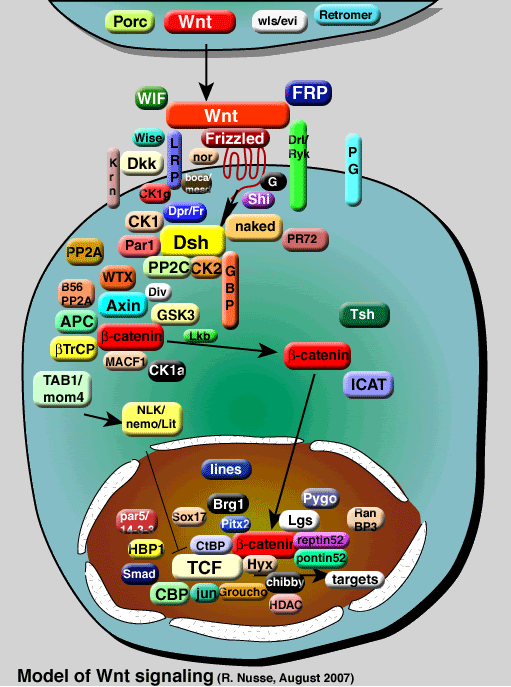
Many thanks to the Nusse Lab at Stanford for their great Wnt cartoons and wealth of research on the topic!