Showing posts with label stem cells. Show all posts

Monday, February 04, 2008

He Wnt that way


Today marks the beginning of Just Science 2008! The Sequel! To kick things off at the Ripsaw, we're delving into a crossover of some of the work I currently research as well as one of my favorite topics, signal tranduction.

Organization within a multicellular body like ourselves or sea cucumbers means we have a lot of cells that all need to be coordinated together, which if you try to think about the enormity of that task as a whole for more than ten seconds, blood will shoot out of your nose, which, ironically would also be a complex symphony of signals amongst literally trillions of cells.

So in a very tiny nutshell, scientists working in the fields of developmental biology and molecular genetics have contributed a mountain of data on these systems, and we still only have the most rudimentary grasp on how it's all put together. I'd equate our knowledge of how the various molecular players in the body turn my morning oatmeal into fuel for typing this similar to saying all you know about a car is you put gasoline in this one hole and that makes it go.

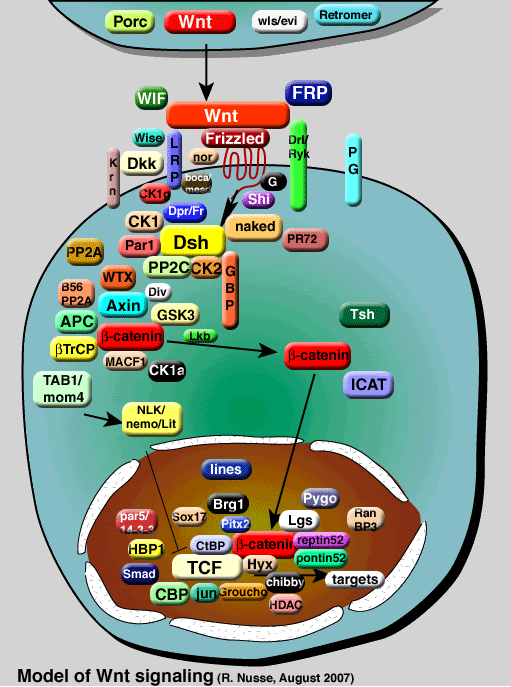
Numerous molecule families have been described and one group that is involved in the dermal remodeling project I currently work on is the Wnt family. Wnt proteins are chiefly paracrine signalers, which means when a cell releases a Wnt molecule, it has a local effect on the tissue. This is in contrast to an endocrine signal such as hormones or other molecules that travel long distances from places such as the brain or thyroid to their target cells. As such, paracrine factors like Wnt molecules have a diffusion effect, their strength of signal proportional to the distance they travel from the cell of origin.

Wnt factors are rich in an amino acid called cysteine which contains sulfur, an atom that allows for some fancy bonding schematics in secondary structures of proteins. The Wnt family is a very old signaling factor and is highly conserved throughout the animal kingdom, found in just about every animal for which it has been probed. In all likelyhood it is the oldest of the signaling factors.

The name Wnt is pretty odd, eh? As is the case with science, we tend to have problems all having the same name for the same molecule, but this is a result of us knowing so little to begin with. Researchers who found the molecule in the Drosophila fruit fly decided to call it wingless since blocking the signal caused the flies to have no wing development. Scientists studying the same factor in vertebrates called it integrated for its role in developing muscle cells in early somite patterning. Once it was established that wingless and integrated were the same thing, a new compromise name was fused together, Wnt.

As someone who has a hand in stem cell research in the hair follicle, Wnt is constantly being brought up as a potential player in the development model. Given its wide-reaching influence in cell-cell interactions, it is often just the big family in the room everyone wants to throw at a model like this. Recent research has certainly suggested the idea is more than plausible, instead of the body just quickly throwing up some scar tissue to secure a wound, it may be possible to turn Wnt genes back on and get the body to create new skin including hair follicles and glands from the foundation up, which would be preferable in so many ways ranging from therapeutic to cosmetic.

The future of Wnt research is a fertile, rich land. New, exciting research ideas surrounding aging are being launched with the Wnt family in mind. In theory, if one can organize a master organizer like Wnt, it might indeed be the secret to tricking the body into thinking it's 21 instead of 61.

Many thanks to the Nusse Lab at Stanford for their great Wnt cartoons and wealth of research on the topic!

Wednesday, January 23, 2008

Hopefully we can remember where we put those extra cells

New preliminary research out of UC-Irvine shows the discovery of a creator gene responsible for differentiating cells into brain tissue. This is a key element in creating a stem cell line of cells that could be used to regenerate brain tissue in patients with diseases like Alzheimer's.

These genes are highly selective, and likely only operate in a small window of time during early development. It would be interesting to see what a homolog gene does in other organisms, as it might provide insight as to how we got our big juicy think-globs. Mmmmm, thinky.

Thursday, January 17, 2008

Exciting new frontiers

Hey there!

Between a rush of holiday activity and a near month of malaise the Ripsaw had gone dark. Hopefully I'll be able to bring you the tasty science news you desire in the future. In the meantime, the world of stem cells has been all a quiver...

Human heart tissue grown from stem cells. A real great leap given the times, this is the leap from mere bits of progenitor cells towards something that might be used to build a new heart that could be put into use to save lives. These would be grown on a scaffold of collagen, which dovetails on previous Ripsaw reports.

Singapore considering human-animal chimeras. This is the type of bold research you'd expect Singapore and perhaps Taiwan to champion, so it will be interesting to observe what comes of such research. Without a doubt, these 'cybrid' studies will be essential to carefully bridging stem cell applications to people.

Tuesday, November 20, 2007

Another big hurdle.


Two research groups form human embryonic human stem cells from somatic tissues.

The actual data can be found here and here.

Woooo boy. This is potentially a big jackpot for science, as it would have a twofold effect. One, the techniques described are fairly simple where any cell lab with tissue culture facilities could likely generate these lines. Two, it would probably get the religiously outraged off the backs of scientists as well. I say probably because it's unclear whether a embryonic-like stem cell line still qualifies as life in need of protection, considering the bizarre demarcations they currently use are rather arbitrary.

A couple observations.

First, both techniques use an ecotropic retrovirus, which is probably completely out of the question for therapeutic use. There's nothing to inactivate this in the system described. Perhaps more of a concern is the cocktail of genes used, where both labs use a pair of oncogenes, or cancer-promoters. Naturally these kind of genes encourage the kind of proliferation you see in stem cells, but it clearly could pose a more immediate danger in the body.

More importantly, while these findings are very exciting, it remains to be seen how viable they are in the pursuit of stem cell therapies, which is the endgame scenario for this research. Until the process is entirely vetted it should not be hailed as some singular panacea to the controversial debate, and is likely to generate new problems that were out of reach previously.

Friday, November 09, 2007

When one of my cultures die, I die a little inside, too.


Scientists construct a stem cell scaffold from seaweed products.

Now, as compared to yesterday's antics, this kind of technology is taking a credible step towards legitimate therapeutic applications. Stem cells in culture are notoriously picky; they typically like to be fed only from one side, need to have their media changed routinely and need to be grown on special membrane substrates. Ostensibly, this presents a problem in the body, where such furnishings are unlikely to be found. An inert scaffold presents its own problems - what happens when you need to take the construction equipment out after everything has grown over?

Ashton, created the device from a material known as alginate. Alginate is a complex carbohydrate found naturally in brown seaweed. When mixed with calcium, alginate gels into a rigid, three-dimensional mesh.


This is a real clever synergy of biochemistry, materials science and engineering. I'd call it the great grandson of the modern disposable diaper, another life saving invention.

Thursday, November 08, 2007

FecundoCapitalism

Hey, Ladies.

Are you worried your monthly miracle is going down the drain? Literally? C'elle to the resuce! For a mere $1500 a year this company will take your glorious discharge and all its potential stem cells and keep it nice and safe in the event you might want it back, to, uh....well really, there's nothing you can do with it right now.

Honestly, this venture is long on optimism and short on evidence. Their product is hope, not an actual scientific technique.

But let's not be too hasty, as Dave Foley from the Kids in the Hall once said...

Cause after all, what is it? a cluster of blood vessels, awaiting a fertilized egg. Providing a safe warm place for that egg to grow. And if a life does not occur, the whole thing is flushed away, and the cycle begins again. Now is that anything to be ashamed of or disgusted by? No, this is the nesting stuff of humanity!

That's why the woman I shall love will be able to menstruate as fully and freely as she desires. Even if her monthly flow should build in intensity to a raging rust colored torrent! An unbridled river of life giving blood flowing from between her legs! An awesome cataract plunging off the edge of our couch. I wouldn't be fazed! No, no, even if coureur de bois would come up stream, battling the rapids, and singing a 'jaunty song'! I would take no offense, rather I would ford across that mighty womanly river, and fetch herbal tea and Pamprin. And then I would mop her brow and admire her fecundity. For I...Have A Good Attitude....Towards MENSTRUATION!

Wednesday, November 07, 2007

Taste the Brainbow


Stem cells may secret brain repair substance. What happens when you take a deficient rodent brain and inject it with stem cells? Brain rescue, at least in Alzheimer's-like mice models. This is a more elaborate variation on seminal work from last year.

Rather, the group speculates that the transplanted cells secreted protective neurotrophins, proteins that promote cell survival by keeping neurons from inducing apoptosis (programmed cell death).


What's interesting here is how malleable the system is. The brain is no different than the muscle or the skin in that it can respond to simple biochemical stimuli. Hook and levers, people, hooks and levers.

LaFerla's team genetically engineered mice to lose cells in their hippocampus, a region in the forebrain important for short-term memory formation. These mice were about twice as likely than unaltered rodents to fail a test of their ability to discern whether an object in a cage had been moved since their previous visit.


It would be interesting to see what kind of effect this model would have on the amygdala, the repository of emotional responses and almost always the first target of dementia diseases like Alzheimer's. However, I suppose it is difficult to tell if a mouse if more or less sad than the day before, and they aren't too forthright with that information.

The next step is to isolate this neurotrophin and throw it into a series of in vitro models, see what kinds of things pop up. A little combinatorial chemistry could begin to define what molecular appendage is the business end.

The chances of succumbing to a dementia like Alzheimer's has risen from about 1 in 6 to over 1 in 5 with our slowly creeping increase in life expectancy. With a tsunami of Baby Boomers turning 60, a sense of urgency is likely going to flock towards work of this nature very soon.

Wednesday, January 17, 2007

Stem Cells, Shmem Shmells.

Thought I'd toss a few thoughts up here regarding the latest news on stem cells, as there's been a bunch.

I'm sure most have seen the big splash in the Washington Post about amniotic stem cells. This is because adult stem cells are fairly limited in what they offer for research and embryonic stem cells have all sorts of political issues surrounding their fair use in science. Prior to that report came this one from South Korea where there is work on producing cloned embryonic stem cells. The moral outrage on this procedure has yet to be accurately gauged, but I suspect it won't pass the litmus test, the C-word tends to upset people for somewhat curious reasons.

Of course, there appear to be tremendous results just around the corner. Parkinson's is one of those home run targets that will likely get a lot of attention in the mainstream press. President Bush has only vetoed one bill in his time in office, and of course, that was stem cell funding from last year. Congress is going to take another run at this legislation, but don't expect any surprises, it will likely meet a similar fate.

What this all means is the science is making big strides both in the forward and lateral motion. Amniotic stem cells are a big deal, but it does not eliminate any need for embryonic stem cells for research. If anything, it intesifies the need for them in the short term. Science, as always, is a cumulative, endless task. Waiting excitedly for the end would be a lot like waiting for Godot.

Monday, October 30, 2006

Back in Black

I'm back! After a busy October full of vacations and business sundry, I'm dusting off the ol' ripsaw to make some boards of logic so that I might barricade the zombies of ignorance! Tis the season.

Stem Cells get the once over at ES conference.

I do a bit o' stem cell culturing in my work, so I'm always on the prowl for new technology and information concerning these hot-button tissue lines. Makes Thanksgiving all the more merry.