Coral soaks up the UV rays to protect the reef citizens.
UV has a habit of zapping DNA and triggering thymine dimers, pretty much irreversible snags in the flowing template of life. Apparently that calcium carbonate isn't just for swanky-looking underwater condominiums, it can protect in any form right down to ground up slurry.
Tuesday, December 01, 2009


Monday, November 30, 2009
Running down rogue cells with the handcuffs.
Zapping cancer cells with magnetic nanodiscs.
Reminds me of this obscure JLA character named Pulse 8, who could drop attach these discs to people magnetically and then increase the weight exponentially.
Reminds me of this obscure JLA character named Pulse 8, who could drop attach these discs to people magnetically and then increase the weight exponentially.
Saturday, November 28, 2009
Monday, November 23, 2009
A turkey never voted for an early Christmas or a biochemical albatross
I always remember a Seinfeld episode where Jerry and George become addicted to playing with an antique toy collection belonging to Jerry's girlfriend, and use wine and turkey to drug her into naps. What's that thing in turkey that makes you sleepy, George and Jerry? Tryptophan!
So it hazards a chance that sometime after your family Thanksgiving meal, when the kids have long left the table and the Detroit Lions are embarrassing themselves in their lone annual national appearance, someone will look around at the clan, delirious from a giant meal and trot out an old trope as to why all the logy faces - that mischievous, impish molecule - tryptophan - has put us all to sleep, said to be found in titanic proportions in that marquis entree, the turkey.
Tryptophan myths and what really brings you down on Happy T - the technical term being post-prandial somnolence - have been running around the Thanksgiving table like chummy cousins for at least the last twenty five years. But indeed, there's little credence to the idea tryptophan is an ultimate torpor torpedo.
Tryptophan is one of those 20 essential molecules called amino acids that humans need to find in their diet as the body lacks sufficient metabolic machinery to effectively create them from other materials. Amino acids are the building blocks of peptides or more commonly, proteins of all styles which make up you and me and buffaloes, Venus flytraps and the H1N1 influenza virus. The amino acids are all like various types of construction material with their own individual character. Some make loops and some make bends, others are straight and others have side chains like branches of a tree, sticking out in various means to provide all sorts of flavor to your protein creation. Tryptophan also offers some other uses to living things, being a precursor of plant-growing hormones called auxins or the essential nutrient niacin, Vitamin B3. A variant of tryptophan is even used by the curious cone snail as a component of its venom, contryphan, a neurotoxin it can jab into prey with its harpoon-like tongue called a radula.
The seed of this myth likely comes from a series of experiments at Oxford University where people were asked to drink a special amino acid mixture and then have them participate in the Prisoner's Dilemma, a game based on mutual cooperation. As players were deprived of tryptophan in their drink, indeed, those players will significantly less likely to cooperate. So there does appear to be a biochemical underpinning to the myth. Tryptophan is the substrate, or starting material for the synthesis of serotonin and in turn, melatonin, neurotransmitters both of which have a hand in regulating our circadian rhythm and need for sleep. From here it's just an irrational but tempting leap to conclude that big delicious bird is going to put you down for a few hours as it jams your head full of sleepy chemicals.
But that's not the end of the story.
While you can find tryptophan in turkey, there's no more per gram of protein than you'd find in chicken or cod or even beef. Indeed, there are a multitude of foods where tryptophan racks up in abundance including milk, eggs, soybeans and sesame seeds. You'd soak your system in tryptophan at about double the rate if you drank milk at equal levels you ate turkey. To go even further, tryptophan is the least abundant amino acid commonly found in natural protein, so as you load all that turkey into our guts, tryptophan has to get into the brain by the same blood-brain barrier gateways as all the other, far more abundant proteins. The stunning fact is your tryptophan levels in your brain (and thus, able to sing its psychotropic lullaby) will actually decrease with a meat-rich Thanksgiving meal of any stripe.
So chances are good that not only are the tryptophan levels in turkey insufficient to trigger a sleepy state in their best cases, they likely never get anywhere near a location of effect due to the giant protein meal actually depleting tryptophan levels as the large quantity aminos bull their way into the brain.
A better culprit of that bloaty corpse feeling? Those dreaded carbs.
It's a well-established fact in multiple animal models and human experiments that ingesting large volumes of carbohydrates provokes the release of insulin into the bloodstream. Insulin promotes the absorption of of branched amino acids, specifically large neutral branched chain amino acids into the muscle, but not tryptophan. This leaves tryptophan in the blood without competition as we saw earlier to get through that blood-brain barrier gateway. Once in the brain, then the raphe nuclei - the serotonin factories of the brain suddenly get a big shipment of tryptophan, convert it into serotonin and then to melatonin, the master sleep neurohormone,in the pineal gland, and turn the lights out. While tryptophan is a player in this model, it is those helpings of potatoes, stuffing, cranberry sauce and pie that put you down on the couch until those Turducken drumsticks are handed out to whomever whipped the Lions that day.
Tryptophan was actually marketed in the late 1980's as a diet supplement, boasted as a cure-all for depression, seasonal affective disorder, hypertension, obesity and even obsessive-compulsive disorder. A contaminated batch of L-tryptophan that led to the disability of hundreds and the deaths of 37 people, triggering a ban from the FDA in 1991. After the dust had settled and the contamination well-characterized, the FDA scaled back the ban in 2001 but still expressed skepticism:
"Based on the scientific evidence that is available at the present time, we cannot determine with certainty that the occurrence of EMS in susceptible persons consuming L-tryptophan supplements derives from the content of L-tryptophan, an impurity contained in the L-tryptophan, or a combination of the two in association with other, as yet unknown, external factors" Link
So enjoy that Happy T this year, take time to listen to grandma, take the Lions lightly, and have fun. But whatever you do, when you begin to feel catatonic, don't blame the tryptophan.
Maybe Jerry's girlfriend is just a lightweight drinker, afterall.
So it hazards a chance that sometime after your family Thanksgiving meal, when the kids have long left the table and the Detroit Lions are embarrassing themselves in their lone annual national appearance, someone will look around at the clan, delirious from a giant meal and trot out an old trope as to why all the logy faces - that mischievous, impish molecule - tryptophan - has put us all to sleep, said to be found in titanic proportions in that marquis entree, the turkey.
Tryptophan myths and what really brings you down on Happy T - the technical term being post-prandial somnolence - have been running around the Thanksgiving table like chummy cousins for at least the last twenty five years. But indeed, there's little credence to the idea tryptophan is an ultimate torpor torpedo.
Tryptophan is one of those 20 essential molecules called amino acids that humans need to find in their diet as the body lacks sufficient metabolic machinery to effectively create them from other materials. Amino acids are the building blocks of peptides or more commonly, proteins of all styles which make up you and me and buffaloes, Venus flytraps and the H1N1 influenza virus. The amino acids are all like various types of construction material with their own individual character. Some make loops and some make bends, others are straight and others have side chains like branches of a tree, sticking out in various means to provide all sorts of flavor to your protein creation. Tryptophan also offers some other uses to living things, being a precursor of plant-growing hormones called auxins or the essential nutrient niacin, Vitamin B3. A variant of tryptophan is even used by the curious cone snail as a component of its venom, contryphan, a neurotoxin it can jab into prey with its harpoon-like tongue called a radula.
The seed of this myth likely comes from a series of experiments at Oxford University where people were asked to drink a special amino acid mixture and then have them participate in the Prisoner's Dilemma, a game based on mutual cooperation. As players were deprived of tryptophan in their drink, indeed, those players will significantly less likely to cooperate. So there does appear to be a biochemical underpinning to the myth. Tryptophan is the substrate, or starting material for the synthesis of serotonin and in turn, melatonin, neurotransmitters both of which have a hand in regulating our circadian rhythm and need for sleep. From here it's just an irrational but tempting leap to conclude that big delicious bird is going to put you down for a few hours as it jams your head full of sleepy chemicals.
But that's not the end of the story.
While you can find tryptophan in turkey, there's no more per gram of protein than you'd find in chicken or cod or even beef. Indeed, there are a multitude of foods where tryptophan racks up in abundance including milk, eggs, soybeans and sesame seeds. You'd soak your system in tryptophan at about double the rate if you drank milk at equal levels you ate turkey. To go even further, tryptophan is the least abundant amino acid commonly found in natural protein, so as you load all that turkey into our guts, tryptophan has to get into the brain by the same blood-brain barrier gateways as all the other, far more abundant proteins. The stunning fact is your tryptophan levels in your brain (and thus, able to sing its psychotropic lullaby) will actually decrease with a meat-rich Thanksgiving meal of any stripe.
So chances are good that not only are the tryptophan levels in turkey insufficient to trigger a sleepy state in their best cases, they likely never get anywhere near a location of effect due to the giant protein meal actually depleting tryptophan levels as the large quantity aminos bull their way into the brain.
A better culprit of that bloaty corpse feeling? Those dreaded carbs.
It's a well-established fact in multiple animal models and human experiments that ingesting large volumes of carbohydrates provokes the release of insulin into the bloodstream. Insulin promotes the absorption of of branched amino acids, specifically large neutral branched chain amino acids into the muscle, but not tryptophan. This leaves tryptophan in the blood without competition as we saw earlier to get through that blood-brain barrier gateway. Once in the brain, then the raphe nuclei - the serotonin factories of the brain suddenly get a big shipment of tryptophan, convert it into serotonin and then to melatonin, the master sleep neurohormone,in the pineal gland, and turn the lights out. While tryptophan is a player in this model, it is those helpings of potatoes, stuffing, cranberry sauce and pie that put you down on the couch until those Turducken drumsticks are handed out to whomever whipped the Lions that day.
Tryptophan was actually marketed in the late 1980's as a diet supplement, boasted as a cure-all for depression, seasonal affective disorder, hypertension, obesity and even obsessive-compulsive disorder. A contaminated batch of L-tryptophan that led to the disability of hundreds and the deaths of 37 people, triggering a ban from the FDA in 1991. After the dust had settled and the contamination well-characterized, the FDA scaled back the ban in 2001 but still expressed skepticism:
"Based on the scientific evidence that is available at the present time, we cannot determine with certainty that the occurrence of EMS in susceptible persons consuming L-tryptophan supplements derives from the content of L-tryptophan, an impurity contained in the L-tryptophan, or a combination of the two in association with other, as yet unknown, external factors" Link
So enjoy that Happy T this year, take time to listen to grandma, take the Lions lightly, and have fun. But whatever you do, when you begin to feel catatonic, don't blame the tryptophan.
Maybe Jerry's girlfriend is just a lightweight drinker, afterall.
Tuesday, November 17, 2009
Calm down and protect the ticker.
New study finds meditation cuts down heart attack risk.
Sorta reminds me how the Dalai Lama can apparently surge his stem cell count through sheer thought.
Sorta reminds me how the Dalai Lama can apparently surge his stem cell count through sheer thought.
Monday, January 05, 2009
Via Pharyngula:
15 Evolutionary Gems: A body of evidence published in the last decade that flexes the considerable intellectual muscle of Evolutionary Theory.
1. The discovery of Indohyus, an ancestor to whales.
2. The discovery of Tiktaalik, an ancestor to tetrapods.
3. The origin of feathers revealed in creatures like Epidexipteryx.
4. The evolution of patterning mechanisms in teeth.
5. The developmental and evolutionary origin of the vertebrate skeleton.
6. Speciation driven indirectly by selection in sticklebacks.
7. Selection for longer-legged lizards in Caribbean island populations.
8. A co-evolutionary arms race between Daphnia and its parasites.
9. Non-random dispersal and gene flow in populations of great tits.
10. Maintenance of polymorphisms in populations of guppies.
11. Contingency in the evolution of pharyngeal jaws in the moray.
12. Developmental genes that regulate the shape of beaks in Darwin's finches.
13. Evolution of regulatory genes that specify wing spots in Drosophila.
14. Evolution of toxin resistance.
15. The concept of evolutionary capacitance: the idea that environmental stress can expose hidden variations that are then subject to selection.
15 Evolutionary Gems: A body of evidence published in the last decade that flexes the considerable intellectual muscle of Evolutionary Theory.
1. The discovery of Indohyus, an ancestor to whales.
2. The discovery of Tiktaalik, an ancestor to tetrapods.
3. The origin of feathers revealed in creatures like Epidexipteryx.
4. The evolution of patterning mechanisms in teeth.
5. The developmental and evolutionary origin of the vertebrate skeleton.
6. Speciation driven indirectly by selection in sticklebacks.
7. Selection for longer-legged lizards in Caribbean island populations.
8. A co-evolutionary arms race between Daphnia and its parasites.
9. Non-random dispersal and gene flow in populations of great tits.
10. Maintenance of polymorphisms in populations of guppies.
11. Contingency in the evolution of pharyngeal jaws in the moray.
12. Developmental genes that regulate the shape of beaks in Darwin's finches.
13. Evolution of regulatory genes that specify wing spots in Drosophila.
14. Evolution of toxin resistance.
15. The concept of evolutionary capacitance: the idea that environmental stress can expose hidden variations that are then subject to selection.
Tuesday, June 17, 2008
Stimulant Surprise
Sometimes you just need that extra oomph to get through the day.
Today's NY Times had an interesting article about the smell of coffee and how that scent alone can have a gene-activating effect on the brain. The reality is the vast majority of our genes are almost always mothballed away, tightly bound to inhibit and regulate their expression by methyl groups and G-C rich zippers. However, get the right stimulant and the cell will release that tight grip and allow amazingly fast transcription of genes to build proteins that in this case, get the brain moving off of sleepy maintenance mode and on to the business of minding...uh, one's business.
Still, one cannot live on stimulants alone, and another research group has shown some compelling evidence for that thing we all likely got in preschool and kindergarten: The afternoon nap. The one real perk I miss from one of my former labs is that the New Age building had nap rooms, and boy did I ever take advantage. A snappy 20 minute snooze around 2pm made not only the rest of the work day but the night as well a time of full production and activity.
Really, those lab sombreros I invented back in grad school make great sense.
Today's NY Times had an interesting article about the smell of coffee and how that scent alone can have a gene-activating effect on the brain. The reality is the vast majority of our genes are almost always mothballed away, tightly bound to inhibit and regulate their expression by methyl groups and G-C rich zippers. However, get the right stimulant and the cell will release that tight grip and allow amazingly fast transcription of genes to build proteins that in this case, get the brain moving off of sleepy maintenance mode and on to the business of minding...uh, one's business.
Still, one cannot live on stimulants alone, and another research group has shown some compelling evidence for that thing we all likely got in preschool and kindergarten: The afternoon nap. The one real perk I miss from one of my former labs is that the New Age building had nap rooms, and boy did I ever take advantage. A snappy 20 minute snooze around 2pm made not only the rest of the work day but the night as well a time of full production and activity.
Really, those lab sombreros I invented back in grad school make great sense.
Friday, February 15, 2008
Playing with food never felt so artistic.

Enjoy here the bizarre and outright wild stylings of the Vienna Vegetable Orchestra, a group that generates its music exclusively from specialized produce they pick up from the grocer the day of the show.
The instruments require occasional lubrication during the performances, as the hot lights of a stage performance will begin to dry the raw plants, and that can apparently change the sound various carrot recorders and cucumberophones make, so they much dip them in water between pieces and sets.
The best part? They make a soup out of the instruments after the show and share with the audience.
Tuesday, February 12, 2008
Fabulous Games and Prizes - in the lab.
I'm sure many readers are aware of the X Prize for various goals reached in commercializing the space race, as illustrated by the landmark (spacemark?) achievement by SpaceShipOne in 2004. But did you know there are X Prizes for cell crushers too?
There's another cool 10 million bucks out there for the ability to cut the cost of genomic sequencing into the affordable range, that is, to sequence one person's entire genome for less than a thousand dollars.
There appears to be several groups that are going to make this a photo finish.
The possibilities of such a cheap and afforable technology are staggering, as one's genome would become core information in medical files, allowing treatments and therapies to be targeted with greater precision.
I recall in 1994 as a college freshman I went to a seminar with a representative of the Human Genome Project, then working on merely sequencing a composite of the complete genome. I was told of the industrious effort being put into this project, a thousand computers crunching millions of numbers non-stop with a target of around 2006. Not only did the HGP beat that goal by a long shot, they were almost usurped by a private company! The merger into the HGP is its own sordid story, alas. Never the less, the acceleration curve of our technology is staggering sometimes.
There's another cool 10 million bucks out there for the ability to cut the cost of genomic sequencing into the affordable range, that is, to sequence one person's entire genome for less than a thousand dollars.
There appears to be several groups that are going to make this a photo finish.
The possibilities of such a cheap and afforable technology are staggering, as one's genome would become core information in medical files, allowing treatments and therapies to be targeted with greater precision.
I recall in 1994 as a college freshman I went to a seminar with a representative of the Human Genome Project, then working on merely sequencing a composite of the complete genome. I was told of the industrious effort being put into this project, a thousand computers crunching millions of numbers non-stop with a target of around 2006. Not only did the HGP beat that goal by a long shot, they were almost usurped by a private company! The merger into the HGP is its own sordid story, alas. Never the less, the acceleration curve of our technology is staggering sometimes.
Monday, February 11, 2008
Like a big 'You Are Here' sign
I'm sure you've heard of the news last month of UFO sightings in Stephenville, Texas. One of my colleagues queried me if I felt there was any legitimacy to the story - could the UFO actually be some intelligent and advanced alien life?
Unfortunately, my answer is a dull almost certainly no. I feel there is plenty of good evidence to suggest life as we know it could arise independently across the universe. Given we have at least a grasp that how things are put together here (like stars and matter) this is probably how they are put together elsewhere. Also, given the vastness of space and the cosmically short time it has taken us to go from polymer goo to intelligent life, it seems ignorant to assume we are in some special and unique nook of the Big Everything, and everywhere else is just void storage.
That said, I also think us meeting up with another indendently arising alien race is also unlikely, for the very same enormity of the universe.
Our little probes, our pollution of the planet, our TV, radio and light waves, even our active search for aliens are riding on a lot of luck to suddenly be noticed by anyone, even if they are taking a hard look at our solar system.
The real trick would be to construct something BIG, and I think Jaron Lanier has the right idea: start moving stars around. Lanier proposes building up a fleet of gravitational tugs or tractors to move objects around, eventually one could get enough of them to start influencing a star's movement. From there, the idea is simply one of scale:
Why move stars around? Because then they could be guided into orbital formations that almost certainly would not have occurred naturally. An imaginable set-up period of tens of thousands of years could therefore be leveraged into a much longer period—billions of years, perhaps—during which aliens could observe the fruits of our efforts. A group of stars organized to present a sign in this way might be called a “graphstellation” (like a constellation, but also a form of writing).
Yeah, the bumps in the roads are almost as big as the objects that are being suggested to be moved into some sort of kitschy Vegas eyesore. Still, I think this is the first proposal I've heard of that even gets close to achieving what so many people feel they've done in Stephenville, Texas - get noticed by little green men.
Unfortunately, my answer is a dull almost certainly no. I feel there is plenty of good evidence to suggest life as we know it could arise independently across the universe. Given we have at least a grasp that how things are put together here (like stars and matter) this is probably how they are put together elsewhere. Also, given the vastness of space and the cosmically short time it has taken us to go from polymer goo to intelligent life, it seems ignorant to assume we are in some special and unique nook of the Big Everything, and everywhere else is just void storage.
That said, I also think us meeting up with another indendently arising alien race is also unlikely, for the very same enormity of the universe.
Our little probes, our pollution of the planet, our TV, radio and light waves, even our active search for aliens are riding on a lot of luck to suddenly be noticed by anyone, even if they are taking a hard look at our solar system.
The real trick would be to construct something BIG, and I think Jaron Lanier has the right idea: start moving stars around. Lanier proposes building up a fleet of gravitational tugs or tractors to move objects around, eventually one could get enough of them to start influencing a star's movement. From there, the idea is simply one of scale:
Why move stars around? Because then they could be guided into orbital formations that almost certainly would not have occurred naturally. An imaginable set-up period of tens of thousands of years could therefore be leveraged into a much longer period—billions of years, perhaps—during which aliens could observe the fruits of our efforts. A group of stars organized to present a sign in this way might be called a “graphstellation” (like a constellation, but also a form of writing).
Yeah, the bumps in the roads are almost as big as the objects that are being suggested to be moved into some sort of kitschy Vegas eyesore. Still, I think this is the first proposal I've heard of that even gets close to achieving what so many people feel they've done in Stephenville, Texas - get noticed by little green men.
Friday, February 08, 2008
The Six Million Watt Man (1.2 million miles of travel not included)
A research team unveils a device that convert leg energy into electrical energy. In principle its exactly how hybrid cars can use the deceleration of a car by braking as a harvest point for gathering up some extra electrical juice.
As the team reports tomorrow in Science, the braces produced 5 watts of power--enough to run 10 cell phones.
Now we're talking. I'd love to have a little bioelectric zappage on hand for my cell phone and even an LED flashlight. I suppose if I ever had a laptop it would be good motivation to get enough power to turn it on.
The prototype appears lightweight (1.6kgs). I wonder if a more industrious individual could strap on a battery and bank some of those watts, eh? It'd be pretty neat to be able to not have to plug my cell phone in every night and just have it charge as I tool about the lab. Of course, the more noble applications such as insulin pumps and prosthetic limbs, but man, I'd love to drop another chore off my daily decompression routine when I get home from work.
I guess they're still working on getting that USB port for the brain.
As the team reports tomorrow in Science, the braces produced 5 watts of power--enough to run 10 cell phones.
Now we're talking. I'd love to have a little bioelectric zappage on hand for my cell phone and even an LED flashlight. I suppose if I ever had a laptop it would be good motivation to get enough power to turn it on.
The prototype appears lightweight (1.6kgs). I wonder if a more industrious individual could strap on a battery and bank some of those watts, eh? It'd be pretty neat to be able to not have to plug my cell phone in every night and just have it charge as I tool about the lab. Of course, the more noble applications such as insulin pumps and prosthetic limbs, but man, I'd love to drop another chore off my daily decompression routine when I get home from work.
I guess they're still working on getting that USB port for the brain.
Thursday, February 07, 2008
Weather didn't do this Atlantis in
Atlantis lifted off this afternoon despite threats both from gloomy weather and a faulty fuel sensor.
This is a huge mission as the Atlantis shuttle is taking up the Columbus science lab, a five billion (with a BUH) dollar module built by ten European nations. The lab is going to more than double the amount of science that can be done on the international space station once the Atlantis crew gets it attached and running.
I still recall in grade school getting to put down the composition and times tables once every few times a year to watch the shuttle lift off on a TV strapped down to a cart in the glorious theatre that was my classrooms. I may not always agree with the government's expense of funds, but the exploration of space never ceases to feel like a most righteous investment and spectacle.
This is a huge mission as the Atlantis shuttle is taking up the Columbus science lab, a five billion (with a BUH) dollar module built by ten European nations. The lab is going to more than double the amount of science that can be done on the international space station once the Atlantis crew gets it attached and running.
I still recall in grade school getting to put down the composition and times tables once every few times a year to watch the shuttle lift off on a TV strapped down to a cart in the glorious theatre that was my classrooms. I may not always agree with the government's expense of funds, but the exploration of space never ceases to feel like a most righteous investment and spectacle.
Wednesday, February 06, 2008
Micro Machines - Fast Talking Spokesman not included
In Korea a research team has built a really tiny robot. This robot, with six crab legs and being no thicker than a fingernail, is powered by rat cardiomyocytes, heart cells coated over its body. When the cells contract, the legs are pulled together, and the mini-cyborg inches forward, averaging about 100uM a second and close to 50 meters in a week. The robot is fabricated the same way we mold parts for things like cars or toys, just on a very small scale.
Check out the robot walker action here.
So what's the application, eh? Theoretically one could send these tiny robots into the smallest of blood vessels and gland ducts the way we send pipeline pigs into fuel lines for maintenance and information gathering missions. The tiny cyborgs could march in and collect valuable data and perhaps in later versions, effect repairs. That's a ways off, since the robot is going to need to be sturdy enough to force its way through flowing blood, but really, at this point its only a matter of engineering, not principle.
Check out the robot walker action here.
So what's the application, eh? Theoretically one could send these tiny robots into the smallest of blood vessels and gland ducts the way we send pipeline pigs into fuel lines for maintenance and information gathering missions. The tiny cyborgs could march in and collect valuable data and perhaps in later versions, effect repairs. That's a ways off, since the robot is going to need to be sturdy enough to force its way through flowing blood, but really, at this point its only a matter of engineering, not principle.
Tuesday, February 05, 2008
A bucket of coke and a better built house: Fat America
A fantastic new book out, the Fattening of America attempts to get a real headlock on the hard questions as to why and how Americans have become so alarmingly obese. This is the first book I've read that takes a moment to ask a question most books gloss right over: Is a big Fat America a bad thing?
In the book, Eric Finkelstein, a health economist argues that our economy, with its massive increase in productivity through technology, has predisposed us to gaining weight. Our jobs have become more and more sedentary and new medical technology has overall lowered the risk of carrying a few extra or a few dozen extra pounds. The power saw and mechanical lifts have preserved the backs and knees of our construction workforce, but it also allowed them to get chubbed and diabetic. At the same time, our accelerated productivity has made things cheaper and more accessible to the bulk (no pun intended) of the population.
This book also intersects with an intriguing study out this week about how living longer is more expensive than being fat. For many years people have laid into the argument that being obese, and as such being more vulnerable to a host of metabolic diseases is a drain on the health care system. Indeed it seems a healthy individual with a longer life span will have a greater financial impact on government run and private health care than any group of obese individuals could do so.
Clearly in the end there's a lot of non-salient factors such as one's happiness, the impact of obesity on relatives and discrimination and social perception of obesity that aren't well covered here, but this book is truly the first in its field to crack open a lot of stronghold notions that have since gone unchallenged.
In the book, Eric Finkelstein, a health economist argues that our economy, with its massive increase in productivity through technology, has predisposed us to gaining weight. Our jobs have become more and more sedentary and new medical technology has overall lowered the risk of carrying a few extra or a few dozen extra pounds. The power saw and mechanical lifts have preserved the backs and knees of our construction workforce, but it also allowed them to get chubbed and diabetic. At the same time, our accelerated productivity has made things cheaper and more accessible to the bulk (no pun intended) of the population.
This book also intersects with an intriguing study out this week about how living longer is more expensive than being fat. For many years people have laid into the argument that being obese, and as such being more vulnerable to a host of metabolic diseases is a drain on the health care system. Indeed it seems a healthy individual with a longer life span will have a greater financial impact on government run and private health care than any group of obese individuals could do so.
Clearly in the end there's a lot of non-salient factors such as one's happiness, the impact of obesity on relatives and discrimination and social perception of obesity that aren't well covered here, but this book is truly the first in its field to crack open a lot of stronghold notions that have since gone unchallenged.
Monday, February 04, 2008
He Wnt that way
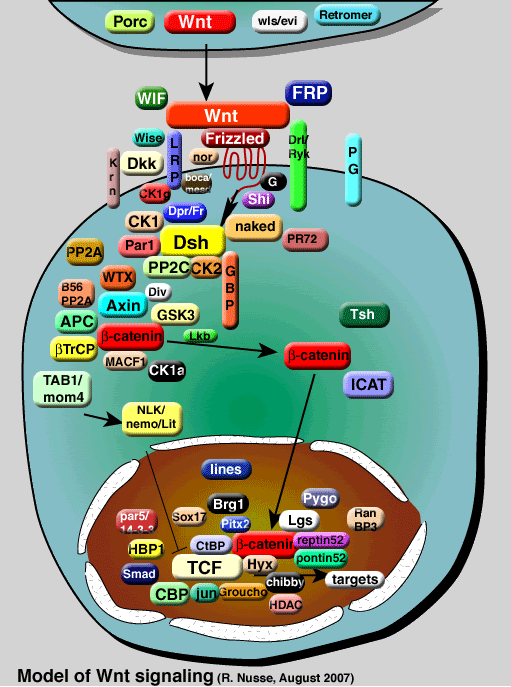
Today marks the beginning of Just Science 2008! The Sequel! To kick things off at the Ripsaw, we're delving into a crossover of some of the work I currently research as well as one of my favorite topics, signal tranduction.
Organization within a multicellular body like ourselves or sea cucumbers means we have a lot of cells that all need to be coordinated together, which if you try to think about the enormity of that task as a whole for more than ten seconds, blood will shoot out of your nose, which, ironically would also be a complex symphony of signals amongst literally trillions of cells.
So in a very tiny nutshell, scientists working in the fields of developmental biology and molecular genetics have contributed a mountain of data on these systems, and we still only have the most rudimentary grasp on how it's all put together. I'd equate our knowledge of how the various molecular players in the body turn my morning oatmeal into fuel for typing this similar to saying all you know about a car is you put gasoline in this one hole and that makes it go.
Numerous molecule families have been described and one group that is involved in the dermal remodeling project I currently work on is the Wnt family. Wnt proteins are chiefly paracrine signalers, which means when a cell releases a Wnt molecule, it has a local effect on the tissue. This is in contrast to an endocrine signal such as hormones or other molecules that travel long distances from places such as the brain or thyroid to their target cells. As such, paracrine factors like Wnt molecules have a diffusion effect, their strength of signal proportional to the distance they travel from the cell of origin.
Wnt factors are rich in an amino acid called cysteine which contains sulfur, an atom that allows for some fancy bonding schematics in secondary structures of proteins. The Wnt family is a very old signaling factor and is highly conserved throughout the animal kingdom, found in just about every animal for which it has been probed. In all likelyhood it is the oldest of the signaling factors.
The name Wnt is pretty odd, eh? As is the case with science, we tend to have problems all having the same name for the same molecule, but this is a result of us knowing so little to begin with. Researchers who found the molecule in the Drosophila fruit fly decided to call it wingless since blocking the signal caused the flies to have no wing development. Scientists studying the same factor in vertebrates called it integrated for its role in developing muscle cells in early somite patterning. Once it was established that wingless and integrated were the same thing, a new compromise name was fused together, Wnt.
As someone who has a hand in stem cell research in the hair follicle, Wnt is constantly being brought up as a potential player in the development model. Given its wide-reaching influence in cell-cell interactions, it is often just the big family in the room everyone wants to throw at a model like this. Recent research has certainly suggested the idea is more than plausible, instead of the body just quickly throwing up some scar tissue to secure a wound, it may be possible to turn Wnt genes back on and get the body to create new skin including hair follicles and glands from the foundation up, which would be preferable in so many ways ranging from therapeutic to cosmetic.
The future of Wnt research is a fertile, rich land. New, exciting research ideas surrounding aging are being launched with the Wnt family in mind. In theory, if one can organize a master organizer like Wnt, it might indeed be the secret to tricking the body into thinking it's 21 instead of 61.
Many thanks to the Nusse Lab at Stanford for their great Wnt cartoons and wealth of research on the topic!
Tuesday, January 29, 2008
The Caffeinator (He'll be back real quick)
We at the Ripsaw enjoy a strong, punch-in-the-face type cup of coffee in the morning, be it Sumatran, Ethiopian or plain or Starbucksy Arabica Breakfast Blend. Indeed, caffeine is often hailed by yours truly as a brain enhancer, a focus accelerant and an all around answer to life in the early hours of the day.=New research, however, shows there is a darker side to caffeine, and it's not all French Roast.
Caffeine mucks with insulin in diabetes.
Caffeine increases risk of miscarriage.
I think there's a unifier here. Caffeine works its magic by keeping a molecule known as cAMP from degrading. With lots of cAMP around, the brain can continue functioning when it would typically trigger fatigue and sleepiness as cAMP levels dropped. Keep the supply fresh and you can go much longer, so to speak.
Here's the thing: cAMP is a nigh-universal metabolic messenger, and is involved in both the metabolism of food as well as complex parts of the reproductive pathways. If you keep cAMP high through caffeine dosing, you're unbalancing something in the body, and in the case of diabetics or pregnant women, there's a much bigger risk involved.
Not that this should keep you from your favorite caffeinated beverage of choice, but perhaps coffee isn't the panacea wunderdrug we'd all like it to be.
Caffeine mucks with insulin in diabetes.
Caffeine increases risk of miscarriage.
I think there's a unifier here. Caffeine works its magic by keeping a molecule known as cAMP from degrading. With lots of cAMP around, the brain can continue functioning when it would typically trigger fatigue and sleepiness as cAMP levels dropped. Keep the supply fresh and you can go much longer, so to speak.
Here's the thing: cAMP is a nigh-universal metabolic messenger, and is involved in both the metabolism of food as well as complex parts of the reproductive pathways. If you keep cAMP high through caffeine dosing, you're unbalancing something in the body, and in the case of diabetics or pregnant women, there's a much bigger risk involved.
Not that this should keep you from your favorite caffeinated beverage of choice, but perhaps coffee isn't the panacea wunderdrug we'd all like it to be.
Monday, January 28, 2008
You wonder who funds them.
America's Funniest home videos wacky science papers.
I'm not sure how farts keep one's personality together, but I'm listening.
I'm not sure how farts keep one's personality together, but I'm listening.
Sunday, January 27, 2008
At the corner of vanity and therapy.
Stem cells give a peak into a possible melanoma breakthrough.
This is actually follow-up research on another breakthrough, the demonstration of a group of receptors, the, yes - ABC family - are key markers for tumor cells. In essence, this can be a unifying tag on the surface of tumor cells that set them apart from the rest of the normal, noncancerous cells in the body. Based on that tag, a therapy might be developed that could use that tag as a target. As mentioned, there are considerations; this receptor, ABCB5, does indeed have a function elsewhere in the body. This is the classic example of what the drug industry likes to call 'side effects'.
Of course, the rub is that melanoma is largely a self-inflicted form of cancer, with the vast majority of cases arising from sun exposure. Might want to make your hat for next summer bigger and floppier, neh?
This is actually follow-up research on another breakthrough, the demonstration of a group of receptors, the, yes - ABC family - are key markers for tumor cells. In essence, this can be a unifying tag on the surface of tumor cells that set them apart from the rest of the normal, noncancerous cells in the body. Based on that tag, a therapy might be developed that could use that tag as a target. As mentioned, there are considerations; this receptor, ABCB5, does indeed have a function elsewhere in the body. This is the classic example of what the drug industry likes to call 'side effects'.
Of course, the rub is that melanoma is largely a self-inflicted form of cancer, with the vast majority of cases arising from sun exposure. Might want to make your hat for next summer bigger and floppier, neh?
Wednesday, January 23, 2008
Hopefully we can remember where we put those extra cells
New preliminary research out of UC-Irvine shows the discovery of a creator gene responsible for differentiating cells into brain tissue. This is a key element in creating a stem cell line of cells that could be used to regenerate brain tissue in patients with diseases like Alzheimer's.
These genes are highly selective, and likely only operate in a small window of time during early development. It would be interesting to see what a homolog gene does in other organisms, as it might provide insight as to how we got our big juicy think-globs. Mmmmm, thinky.
These genes are highly selective, and likely only operate in a small window of time during early development. It would be interesting to see what a homolog gene does in other organisms, as it might provide insight as to how we got our big juicy think-globs. Mmmmm, thinky.
Thursday, January 17, 2008
Exciting new frontiers
Hey there!
Between a rush of holiday activity and a near month of malaise the Ripsaw had gone dark. Hopefully I'll be able to bring you the tasty science news you desire in the future. In the meantime, the world of stem cells has been all a quiver...
Human heart tissue grown from stem cells. A real great leap given the times, this is the leap from mere bits of progenitor cells towards something that might be used to build a new heart that could be put into use to save lives. These would be grown on a scaffold of collagen, which dovetails on previous Ripsaw reports.
Singapore considering human-animal chimeras. This is the type of bold research you'd expect Singapore and perhaps Taiwan to champion, so it will be interesting to observe what comes of such research. Without a doubt, these 'cybrid' studies will be essential to carefully bridging stem cell applications to people.
Between a rush of holiday activity and a near month of malaise the Ripsaw had gone dark. Hopefully I'll be able to bring you the tasty science news you desire in the future. In the meantime, the world of stem cells has been all a quiver...
Human heart tissue grown from stem cells. A real great leap given the times, this is the leap from mere bits of progenitor cells towards something that might be used to build a new heart that could be put into use to save lives. These would be grown on a scaffold of collagen, which dovetails on previous Ripsaw reports.
Singapore considering human-animal chimeras. This is the type of bold research you'd expect Singapore and perhaps Taiwan to champion, so it will be interesting to observe what comes of such research. Without a doubt, these 'cybrid' studies will be essential to carefully bridging stem cell applications to people.
Subscribe to:
Posts (Atom)