A fantastic new book out, the Fattening of America attempts to get a real headlock on the hard questions as to why and how Americans have become so alarmingly obese. This is the first book I've read that takes a moment to ask a question most books gloss right over: Is a big Fat America a bad thing?
In the book, Eric Finkelstein, a health economist argues that our economy, with its massive increase in productivity through technology, has predisposed us to gaining weight. Our jobs have become more and more sedentary and new medical technology has overall lowered the risk of carrying a few extra or a few dozen extra pounds. The power saw and mechanical lifts have preserved the backs and knees of our construction workforce, but it also allowed them to get chubbed and diabetic. At the same time, our accelerated productivity has made things cheaper and more accessible to the bulk (no pun intended) of the population.
This book also intersects with an intriguing study out this week about how living longer is more expensive than being fat. For many years people have laid into the argument that being obese, and as such being more vulnerable to a host of metabolic diseases is a drain on the health care system. Indeed it seems a healthy individual with a longer life span will have a greater financial impact on government run and private health care than any group of obese individuals could do so.
Clearly in the end there's a lot of non-salient factors such as one's happiness, the impact of obesity on relatives and discrimination and social perception of obesity that aren't well covered here, but this book is truly the first in its field to crack open a lot of stronghold notions that have since gone unchallenged.
Showing posts with label epidemiology. Show all posts
Showing posts with label epidemiology. Show all posts
Tuesday, February 05, 2008


Thursday, September 27, 2007
Listen up, maggots.
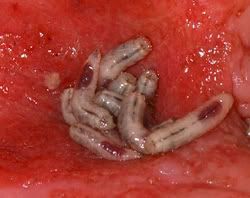
In the realm of totally awesome science, I skipped across this story on my morning drive, and indeed, doctors are now using maggots as part of diabetes treatment. I am beside myself with joy.
While the actual mechanism as to how the beastly little critters work is somewhat nebulous, the basic conceit is thus: Maggots are applied, caged in a series of bandages on the dying tissue, typically on the foot in a diabetic case, and there they chew up or debride the necrotic tissue while leaving the living tissue room to grow, stimulus to do and with little to no incident of infection.
Sunday, March 18, 2007
Unsurprisingly, brain plaque leads to brain decay.
I have excessively robust salivary glands in my lower jaw, which leads to a buildup of tartar behind my lower incisors. Despite all my dental machinations, I end up having two valleys of fossilized plaque scraped out every six months. Unlike tooth plaque, however, brain plaque is neither as innocuous nor so easily removed.
A recent study showed that common inhaled anesthetics can speed up the formation of brain plaques, which are webs of fibrous proteins associated with conditions like Alzheimer's Disease and dementia. The protein, amyloid beta, is also a notorious troublemaker elsewhere in the body, originally described in the study of diabetes. The study showed that inhaling gas such as halothane or isoflurane can indeed increase the presence of brain plaques, which are known to be directly correlated with an increase in Alzheimer's symptoms. Interesting stuff.
These data come on the heels of another interesting story about Alzheimer's, rather that the amyloid beta proteins might have prion-like behavior.
The scientist's reaction seems almost perverse taken out of context:
You can almost see him steepling his fingers and laughing maniacally, no? Did you ever imagine your brain as a disease vector?
It's not all gloom and doom, however, there are strides being made towards actual therapeutics.
Alzheimer's is a condition that strikes fear into most people the way a heart attack or even cancer can't. Alzheimer's breaks down the frontal cortex of the brain, starting with destroying short term memory, then later it breaks down the longer term memory and can spiral towards a complete collapse of being able to perform the most simple of tasks, right down to feeding one's self. It feels like an unraveling of one's humanity thread by thread. I think that drawn-out reduction to non-existence is a pretty paralyzing thought.
Still, one must keep an open mind on the subject of losing one's mind. I know that while the self-destruction of the body is agonizing for family members, it likely is fairly painless for the person. By the time the disease claims the life, the person is in essence, oblivious of one's own passing. There are worse deaths out there.
In any event, I wouldn't put off any necessary surgery based on these findings. Just make sure you do your crossword puzzle while you're on the treadmill, and I'm pretty sure it all comes out even, right?
A recent study showed that common inhaled anesthetics can speed up the formation of brain plaques, which are webs of fibrous proteins associated with conditions like Alzheimer's Disease and dementia. The protein, amyloid beta, is also a notorious troublemaker elsewhere in the body, originally described in the study of diabetes. The study showed that inhaling gas such as halothane or isoflurane can indeed increase the presence of brain plaques, which are known to be directly correlated with an increase in Alzheimer's symptoms. Interesting stuff.
These data come on the heels of another interesting story about Alzheimer's, rather that the amyloid beta proteins might have prion-like behavior.
Scientists have been able to induce brain disease in mice by injecting extracts of the brains of people who died of Alzheimer's disease, a finding that suggests that Alzheimer's has some characteristics of prion brain disorders such as mad cow disease and chronic wasting disease.
The scientist's reaction seems almost perverse taken out of context:
"It's fabulous work," said Sam Gandy, an Alzheimer's researcher and director of the Farber Institute for Neurosciences at Thomas Jefferson University. "This is the first time a brain of a human with Alzheimer's has been used to provoke pathology in another being."
You can almost see him steepling his fingers and laughing maniacally, no? Did you ever imagine your brain as a disease vector?
It's not all gloom and doom, however, there are strides being made towards actual therapeutics.
Alzheimer's is a condition that strikes fear into most people the way a heart attack or even cancer can't. Alzheimer's breaks down the frontal cortex of the brain, starting with destroying short term memory, then later it breaks down the longer term memory and can spiral towards a complete collapse of being able to perform the most simple of tasks, right down to feeding one's self. It feels like an unraveling of one's humanity thread by thread. I think that drawn-out reduction to non-existence is a pretty paralyzing thought.
Still, one must keep an open mind on the subject of losing one's mind. I know that while the self-destruction of the body is agonizing for family members, it likely is fairly painless for the person. By the time the disease claims the life, the person is in essence, oblivious of one's own passing. There are worse deaths out there.
In any event, I wouldn't put off any necessary surgery based on these findings. Just make sure you do your crossword puzzle while you're on the treadmill, and I'm pretty sure it all comes out even, right?
Tuesday, February 06, 2007
(Secret) Viral Agents

In the last two days I've had two people independently ask me about the catching of colds in the Winter months. The Northern part of the States has taken a chill pounding over the past week, and you can expect a rise in sore throats and Kleenex sales.
The battle with the rhinovirus - the virus responsible for most colds - is one of an exponential arms race. With each new defense the body can throw down, the virus adapts, and the process begins anew ad infinitum. A major hurdle we're still dealing with as a species can be attributed to our upright posture
, a severe weakness the virus and other bugs have been exploiting ever since we pushed off our knuckles and primarily moved around on two legs. But that's another story..
A virus is little more than a genetic bomb; most of it's components have evolved specifically to disrupt a human host's immune defenses with the core package a bit of RNA and replication protein to borgify and convert a cell into a virus factory.
The human host is no slouch and takes a layered approach to its considerable defense scheme. There are the anatomic barriers. The skin - a thick morass of cornified cells that appear like a gravelly, barren landscape on the microscopic level, sebum secreted from hair follicles give the skin an acidic, unwelcome feeling. The mucous membranes trap and hold invaders so ciliated hairs can ferry them up towards the mouth or nose for expectorations, as well as providing a home for local bacterial flora that soak up as much attachment space as possible in a competitive binding scenario. Should pathogens get all the way down to the gullet, that's usually a danger as well, as the low pH of the stomach will wilt all but the hardiest pathogens.
But should the virus be crafty enough or lucky enough to find a system compromised and get into the body, the host is not without further tricks. Upon detection by fingerprint-like molecules called antigens, the body can recruit dozens of different specialized cells to fight infection. Dendritic cells and other local watchdogs release signaling molecules called cytokines once they detect these antigens. First responder neutrophils arrive and wage a scorched earth warfare, triggering the inflammation response. Inflammation was originally described as having four qualities: rubor, tumor, calor and dolor. That is to say in modern terms, redness, swelling, heat and pain. All the lovely symptoms you'd associate with an upper respiratory infection, or any healing wound. The cytokine storm unleashed by the neutrophils can bring in a host of warriors depending on what the situation calls for. Massive, multi-nuclear macrophages to engulf and destroy necrotic tissues. Cytolytic killer cells designed to identify virally-infected host cells and punch holes in them with an immunologic cannon, faceted B-cells that churn out antibodies to bind up and help perturb and isolate antigens and eosinophils, the firemen of the body who come in to draw down the inflammatory inferno and bring things back towards normal operations.
Of course, these things don't happen instantly, as much as we'd like them to. It normally takes 3-4 days for a first response and 7-10 days for a human immune system to bring its full arsenal to bear and clear out an invading pathogen. The system is, much like the rest of our operations, susceptible to poor maintenance of the body as a whole. Fatigue, dehydration, poor diets, a lack of exercise - or lingering outside without a hat on in subzero temperatures like Mom warned out about - all such things can leave the body ripe for viral colonization.
A couple extra hand washings and a hat go a long way. Stay healthy this season!
Thursday, December 07, 2006
Riding on the Flu-tails
Over at Rice University scientists have hit upon a new target in the flu wars. Antiviral research is a dense field, given that most screening isn't target specific, mostly because we know so few targets. Identifying this pocket is just the first step, though. Finding a molecule that can get down in there and disrupt the pocket as a viable drug is a whole other flu-tainted enchilada. Still, it's a big step in the right direction, and allows replicon-based screening to move forward with a much more powerful filter on potential compounds. As to whether such a pocket is a drugable target, well, that's like, a whole other flu-filled burrito, or something.
Thursday, October 05, 2006
Two Steps Behind
Ripped from the NYTimes: Conspicuous increased levels of C-reactive protein in the lower class. This cracks open a door of research that's probably very fascinating and socially uncomfortable, but it would be nice if someone would go kick it in.
Thursday, September 14, 2006
Thursday, September 07, 2006
The Whitestest of Diseases
It appears Tuberculosis, sick (dur hur hur) of taking a back seat to youngbloods like AIDS and West Nile, is coming back with a new attitude. I recall freaking out the first time a professor of mine mentioned he had TB, it was a disease I had so little grasp of outside of that little pronged disc they would poke me with for no apparent reason. The new strain is being labeled 'XDR-TB' which we all know adding an X indicates a superpowered version of the previous redeco strain. To quote a pal, it is monsterious, and that X can be so sexy and dangerous. Still, SexyDanger-TB has its own merits...
Bonus Round: Some technical reading for those so inclined. I'm involved in some ATP-biosynthesis targeting, and it's a topic that gets kicked around our pathogen-oriented projects quite a bit.
Bonus Round: Some technical reading for those so inclined. I'm involved in some ATP-biosynthesis targeting, and it's a topic that gets kicked around our pathogen-oriented projects quite a bit.
Subscribe to:
Posts (Atom)